Dentists · From the blog
Dental Website Design for a Small Practice: What a One or Two Chair Office Needs
Search "dentist website design for small practice" and Google will show you a page of "25 best dental websites" listicles, then quietly add the note "Missing: small." Every one of those lists features multi-location groups with photography budgets. None of them are about a one or two chair practice with a front desk of one. This is for that practice.
What a small practice site is actually for
A group practice website is a brand exercise. A small practice website has one job: turn the person who just searched "dentist near me accepting new patients" or "emergency dentist open Saturday" into a booked appointment before they scroll to the next result. Everything on the site should serve that. Design matters, but not as much as answering the four questions every dental patient has: Where are you? Are you taking new patients? Do you take my insurance? Can I get in soon?
The pages a small dental practice needs
Homepage: location, hours, new patients, book
Above the fold: practice name, city, whether you accept new patients, hours, phone, and a book or request appointment button. A photo of the actual office, not a stock photo of a smiling model. Below that, the services you most want to be found for, a few reviews, and a short paragraph about the dentist. That is the whole homepage.
One page per service
Patients search for procedures, not practices: "dental implants cost," "same day crown," "Invisalign near me," "tooth extraction," "kids dentist." Each service you want to be found for needs its own page explaining what it involves, how long it takes, what it typically costs or how you handle estimates, and whether insurance usually covers it. A single Services page with a list ranks for none of them.
Emergency dentistry, with a real answer
Emergency searches are the highest-intent traffic a small practice can get, and they happen at night and on weekends. If you see emergencies, say exactly how: same-day slots, after-hours number, what counts as an emergency, what to do while waiting. If you do not, say that too and point to who does. A vague "we handle emergencies" line converts nobody.
Insurance, financing, and a membership plan
List every plan you are in network with. Explain how out-of-network works. If you offer financing, name it. And if you have an in-house membership plan for uninsured patients, give it its own section with the annual price and what it includes. Membership plans are one of the strongest differentiators a small practice has against groups, and most small practice sites bury them.
New patient information
What to expect at the first visit, how long it takes, what to bring, and a link to complete forms online before arriving. Every form completed at home is ten minutes saved at a one-person front desk.
The dentist and team, with real photos
In a small practice, patients are choosing a person. Your education, years in practice, why you opened the practice, and a photograph that looks like you on a normal Tuesday. Team photos too. This page is often the second most visited on a small practice site.
Reviews, front and center
Pull your Google reviews onto the site, and make asking for them part of checkout. A small practice with 80 recent, specific reviews beats a group with 400 generic ones in local results and in patient trust. How to get more Google reviews covers the process that works without making anyone uncomfortable.
Online booking matters more here than anywhere
Dentistry has an unusual share of after-hours searches. Someone breaks a tooth at dinner and starts searching at 9 pm. If they can request an appointment right then, you have the patient. If they have to call at 8 am, half of them have already booked with whoever let them do it last night. Connect your practice management software's scheduler if it offers one. If not, a simple appointment request form still captures the lead. Either way, make the button impossible to miss on mobile.
How a small practice gets found
The encouraging truth about local dental search is that size barely matters. Google ranks the Business Profile and website that best match the search and the searcher's location. A small practice can win with:
- A complete Google Business Profile. Primary category Dentist, secondaries that match your services (Cosmetic dentist, Emergency dental service, Pediatric dentist, Dental implants provider). Real photos of the office and team, accurate hours including any Saturday hours, and a steady stream of reviews. The Business Profile guide walks through every field.
- Service pages that match searches. Google connects a search to a page. No page, no ranking.
- Consistency. The same practice name, address, and phone on the site, the profile, insurance directories, and every listing.
- Speed. A small practice can respond to a review or an appointment request in minutes. Groups cannot. Google notices response behavior on the profile, and patients notice it everywhere.
Map results usually move in 3 to 6 months. Organic rankings on a new domain take 6 to 12. The month-by-month detail is in how long local SEO takes to work.
What not to buy
Dental marketing is full of bundles: a website, SEO, social posting, and a monthly newsletter for $300 to $1,500 per month on a 12-month contract, usually with a $3,000 to $8,000 build fee on top. For a group, that can make sense. For a one-chair practice, most of it is paying for things that do not bring in patients. You do not need social media posting. You do not need a newsletter. You need a site that answers the four questions, a complete Business Profile, reviews, and time. Be especially wary of any vendor that owns your domain or site at the end of the contract.
What it costs
I build dental practice websites starting at $499 with every page written for you, plus $20 per month for hosting, maintenance, and updates. No contract, and the site is yours. An optional $79 per month growth add-on covers ongoing edits, monthly content, and Business Profile management if you want it handled. Details on the dentist website page, and the general cost comparison across specialties is in what a practice website really costs.
Questions practice owners ask
How much should a small dental practice website cost?
Dental marketing agencies typically charge $3,000 to $8,000 or more to build a site, plus $300 to $1,500 per month for marketing bundles, usually on a 12-month contract. For a one or two chair practice that is out of proportion. I build dental practice websites starting at $499 with every page written for you, plus $20 per month for hosting and maintenance, no contract, and you own the site.
What pages does a small dental practice website need?
A homepage that states location, hours, and whether you take new patients; one page per service you want to be found for (cleanings and exams, emergency care, crowns, implants, clear aligners, kids); an insurance and financing page including any in-house membership plan; new patient information and online forms; the dentist and team page with real photos; reviews; and a contact page with a map and online booking if you offer it.
Do small dental practices need online booking?
It helps more in dentistry than in almost any other specialty. A large share of dental searches happen after hours, especially for emergencies, and a patient who can request an appointment at 9 pm books with you instead of calling someone else at 8 am. If your practice software offers online scheduling, connect it; if not, a simple appointment request form still captures the lead.
How does a one-chair dental office compete with a large group practice on Google?
Locally, size barely matters. Google ranks the Business Profile and website that best match the search and the searcher's location. A small practice with a complete profile, steady reviews, real photos, and a page for each service routinely outranks a large group with a corporate template. Speed of response and personal reviews are advantages small practices have and groups do not.
Want this handled for you?
I build websites for private practice owners: every page written and designed for you until you're satisfied, plus your Google Business Profile set up, starting at $499 with no long-term contracts.
Find your specialty →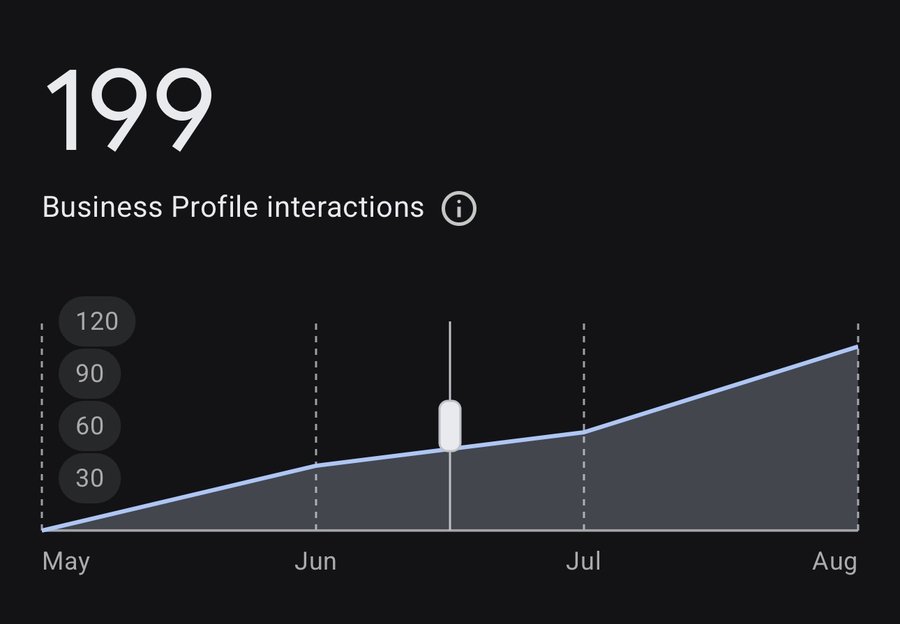
Real Google Business Profile data
199 Business Profile interactions in four months
Straight out of the Google Business Profile dashboard: calls, direction requests, and website clicks from people searching on Google and Google Maps, May through August 2026. Climbing every single month. That is what happens when the Business Profile, the map pack, and the website are all pulling in the same direction.