Psychiatry · From the blog
Psychiatrist Website Design: What a Psychiatric Practice Site Needs in 2026
Search "psychiatrist website design" and the results are mostly Pinterest boards, Dribbble mockups, and template marketplaces. That tells you something: almost nobody is writing about what a psychiatric practice website actually needs, as opposed to what it should look like. Having built and maintained the site for a psychiatric and TMS clinic, I want to fill that gap.
The short version: a psychiatrist's site is not a therapist's site with a different color scheme. Patients arrive with different questions, the compliance surface is bigger, and the searches that bring in new patients are more specific. Get those three things right and the design largely takes care of itself.
Why psychiatric practice websites are different
A prospective therapy client is mostly deciding whether they will feel comfortable with you. A prospective psychiatric patient is deciding that too, but they are also trying to answer practical questions before they call: Do you prescribe? Do you take my insurance? Is this by video? How long is the first appointment? Will you continue the medication my last doctor started? If the site does not answer those, they call the office, the office spends fifteen minutes on a patient who was never a fit, or they book somewhere that did answer.
The second difference is trust. Psychiatry still carries stigma, and patients are more anxious about a first psychiatric appointment than a first primary care visit. A site that reads like a directory listing, or worse, like a marketing funnel, makes that anxiety worse. Calm, specific, and clinical without being cold is the target.
The pages a psychiatrist's website needs
1. Condition and treatment pages, one each
Patients rarely search "psychiatrist." They search "ADHD psychiatrist near me," "medication management for anxiety," "postpartum depression psychiatrist," "Spravato near me." Each of those deserves its own page written in the patient's language, explaining how you evaluate and treat the condition, what a first visit looks like, and who is a good fit. One long "Services" page with a bullet list cannot rank for any of them.
2. Medication management, explained
This is the page most psychiatric sites skip, and it is the one patients most want. Explain what medication management means in your practice: how often follow-ups happen, whether you offer therapy alongside medication or coordinate with an outside therapist, how refills work, and what happens if a medication is not working. Patients transferring from another prescriber want to know you will not make them start over.
3. Telepsychiatry and licensure
If you see patients by video, list every state you are licensed in, plainly, near the top of the telehealth page. Patients in a neighboring state will search for you, and a clear "I see patients located in Texas and South Carolina" line prevents wasted inquiries and protects you. Explain how a video visit works, what platform you use, and what a patient needs to have ready.
4. Controlled substance policy
The rules around prescribing controlled substances by telehealth have shifted repeatedly over the last few years, and patients are confused. Whatever your policy is, put it in writing on the site: whether you prescribe stimulants or benzodiazepines, whether an in-person visit is required first, and whether you require prior records or testing for ADHD evaluations. This single paragraph filters out the majority of mismatched inquiries a psychiatric office receives.
5. Interventional treatments, if you offer them
TMS, Spravato, and ketamine each need a dedicated page. Patients researching these have usually failed two or more medications and have very specific questions: how many sessions, how long each takes, whether insurance covers it, what the criteria are, and what the side effects feel like. The TMS Waco site is a live example: plain-language treatment pages, insurance and referral information answered up front, and a contact path that is careful about what it asks.
6. Insurance, fees, and the private-pay case
List the plans you are in network with, and if you are private pay only, say so and say why in one honest sentence. Post your fees for an initial evaluation and follow-up. Explain superbills and out-of-network reimbursement if that applies. Psychiatric patients are used to being surprised by bills; a practice that is transparent about money earns trust before the first visit.
7. The new-patient process, step by step
What happens after they reach out? How soon can they be seen? What paperwork is needed, and can it be completed online before the visit? How long is the initial evaluation? A numbered list here removes the biggest source of friction in psychiatric intake.
8. Your bio, with credentials that mean something to patients
Board certification, residency, fellowships, and any subspecialty training belong here, but translate them. "Board-certified in psychiatry with additional training in reproductive psychiatry" tells a patient something. "Diplomate, ABPN" does not. A real photo, not a stock one, matters more here than in almost any other specialty.
9. Crisis language
Every psychiatric practice site should state clearly that the website and contact form are not for emergencies, and give the 988 Suicide and Crisis Lifeline number and instructions to call 911 or go to the nearest emergency room. Put it in the footer and on the contact page.
Privacy and compliance details that trip up psychiatric sites
- Contact forms should not collect clinical information. Name, email, phone, and a general "what are you looking for" field is enough. A free-text field labeled "describe your symptoms" invites protected health information into an email inbox.
- No tracking pixels on patient-facing pages that would leak visit intent. Regulators have been explicit that analytics and advertising pixels on pages like "ADHD treatment" can disclose health information. Keep analytics minimal and privacy-respecting, and never install ad platform pixels on condition pages.
- A HIPAA notice and privacy policy that match what the site actually does. Boilerplate that promises encrypted forms when the form emails plain text is worse than no policy at all.
- Accessibility. Patients with ADHD, anxiety, or visual impairment are your patients. WCAG 2.1 AA is the standard, and it is not hard to meet on a well-built site.
How psychiatrists actually get found on Google
Three inputs do almost all of the work. First, a Google Business Profile with Psychiatrist as the primary category, Mental health clinic or Telemedicine as secondaries where accurate, complete hours, real photos, and a steady trickle of reviews. Second, the condition and treatment pages above, because Google matches searches to pages, not to practices. Third, consistency: the same practice name, address, and phone everywhere your practice appears online.
Expect the map pack to move first, usually within 3 to 6 months. Organic rankings on a new domain take 6 to 12 months. Psychiatry is less crowded online than therapy in most markets, so a psychiatric practice that does this properly tends to move faster than a therapist doing the same work. I wrote up the full timeline in how long local SEO takes to work.
What to avoid
- Template subscriptions you never own. If you stop paying, the site disappears. That is a bad position for a practice that will exist for twenty years.
- Stock imagery of brains, pills, and models holding their heads. Patients notice, and it reads as impersonal.
- A single "Services" page. It cannot rank and it does not answer questions.
- Long-term marketing contracts. A 12-month commitment before you have seen results is a warning sign, not a feature.
What it costs
Healthcare marketing agencies typically quote $3,000 to $10,000 or more for a psychiatric practice site, often bundled with a monthly retainer and a contract. Template platforms run $59 to $349 per month indefinitely. I build psychiatrist websites starting at $499 with every page written for you, plus $20 per month for hosting and maintenance, month to month, and the site belongs to you. The full breakdown is in what a practice website really costs, and the psychiatry-specific build is described on the psychiatrist website page.
Questions practice owners ask
How much does a psychiatrist website cost?
Healthcare agencies typically charge $3,000 to $10,000 or more for a psychiatric practice website, often with a 12-month contract on top. Template subscriptions run $59 to $349 per month and never give you ownership. I build psychiatrist websites starting at $499 with every page written for you, plus $20 per month for hosting and maintenance, no long-term contract, and the site is yours.
What pages does a psychiatric practice website need?
At minimum: a homepage that says who you treat and how to start, a page for each condition or service you want to be found for, a medication management page, a telepsychiatry page listing the states you are licensed in, an insurance and fees page, a new-patient process page, your bio with credentials, and a contact path that does not ask for clinical details. Add pages for Spravato, TMS, or ketamine if you offer them.
Should a psychiatrist's website list a controlled substance policy?
Yes, in plain language. Patients searching for ADHD or anxiety treatment want to know before they book whether you prescribe stimulants or benzodiazepines, whether that is available by telehealth, and what an initial evaluation involves. Stating your policy up front filters out mismatched inquiries and saves your front desk hours.
How do psychiatrists get found on Google?
Three things: a Google Business Profile with Psychiatrist as the primary category and steady reviews, a website with a dedicated page for each condition and treatment patients search for, and consistent name, address, and phone details everywhere. Map-pack visibility usually moves within 3 to 6 months; organic rankings on a new domain take 6 to 12.
Want this handled for you?
I build websites for private practice owners: every page written and designed for you until you're satisfied, plus your Google Business Profile set up, starting at $499 with no long-term contracts.
Find your specialty →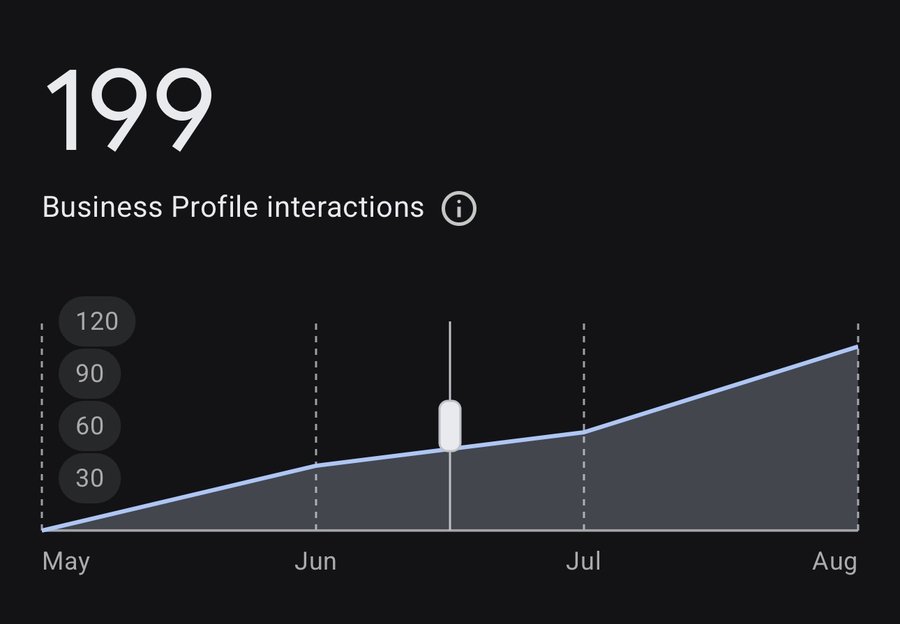
Real Google Business Profile data
199 Business Profile interactions in four months
Straight out of the Google Business Profile dashboard: calls, direction requests, and website clicks from people searching on Google and Google Maps, May through August 2026. Climbing every single month. That is what happens when the Business Profile, the map pack, and the website are all pulling in the same direction.